Share book on
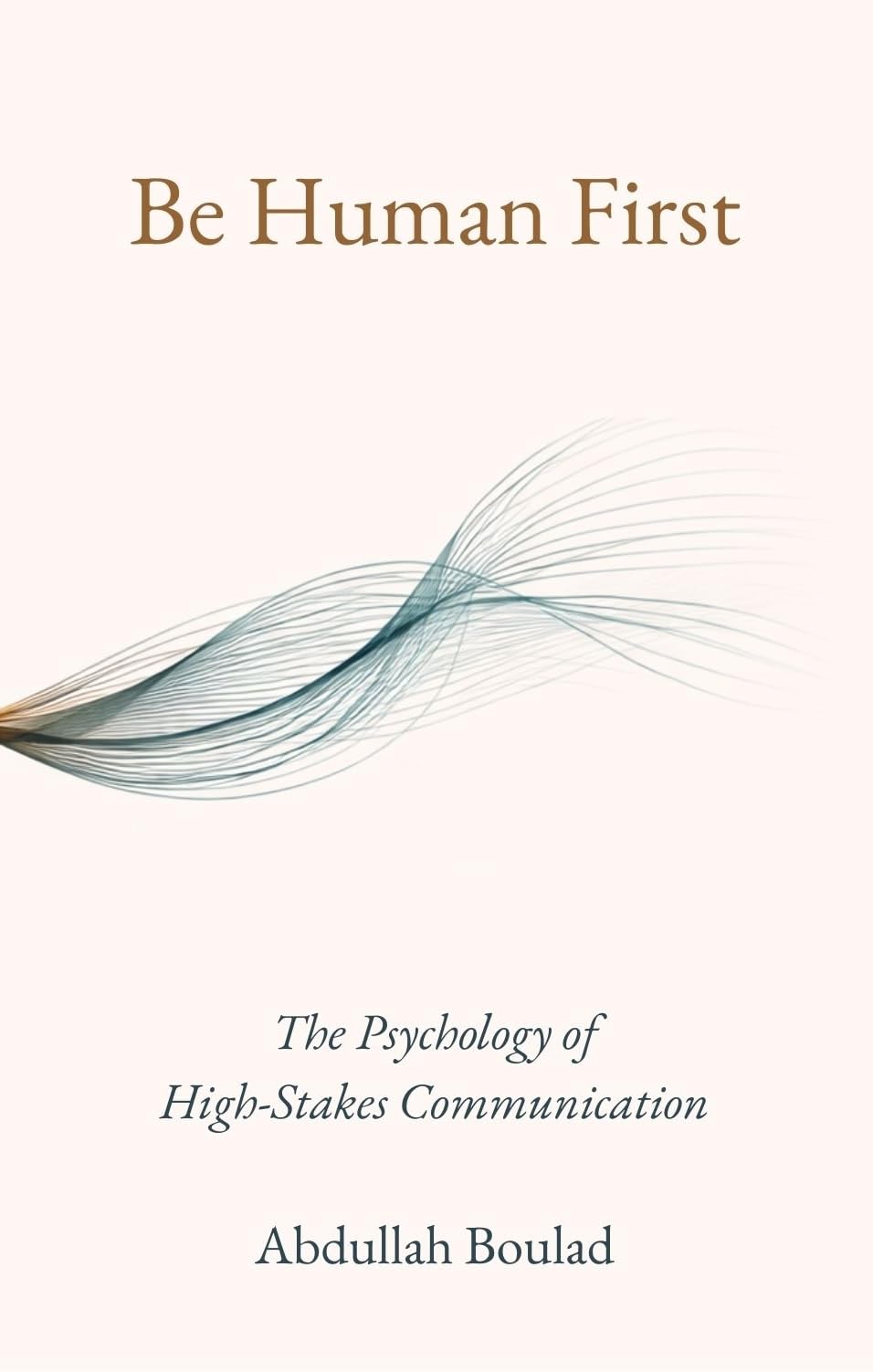
Be Human First
by Abdullah Boulad
Summary
Be Human First explores what happens when communication takes place under pressure — in boardrooms, relationships, leadership, and moments where the stakes are high and the margin for misunderstanding is small.Drawing from years of experience working with individuals facing intense psychological and professional demands, Abdullah Boulad examines communication not simply as a technique, but as a reflection of the human nervous system. When stress rises, the ability to listen, respond, and connect...
From our reviewers
This document is a comprehensive guide on authentic, trauma-informed, and high-stakes communication, focusing on psychological, cultural, and practical aspects. The Foundations of Human Communication Communication begins with early neural development and attunement between caregivers and infants.Trust and emotional regulation shape lifelong patterns of connection and interaction. Impact of Trauma and Emotional Baggage Past wounds influence present responses, often causing reactive behaviors in conversations.Trauma narrows perception, making safe, compassionate exchanges essential for healing. Nervous System's Role in Authenticity Calm, centered states enable genuine connection, while threat responses hinder it.Recognizing bodily cues helps regulate emotions and foster honest communication. Cultural and Identity Influences Language and cultural contexts shape how authenticity and safety are expressed.Self-esteem and social needs drive the desire for recognition and influence interaction style. Neuroscience of Authenticity and Trust Authentic emotional speech activates brain regions linked to social understanding.Living in line with inner values improves well-being and reduces stress. Importance of Nonverbal and Behavior Communication Gestures, tone, facial expressions, and actions convey more than words.Authentic behavior over time builds trust and reflects values. Evolution and Role of Language Early humans communicated through gestures before developing spoken language.Tone and rhythm in speech express emotion and build social bonds. Impact of Written and Digital Communication Lack of nonverbal cues in texts can cause misunderstandings.AI and digital media are transforming language and cognition. Cultural and Personal Conditioning Family shapes early communication; culture influences language's emotional tone.Epigenetics shows environment and experience modify brain responses and styles. Self-Talk and Mind-Body Connection Inner dialogue affects physical health and emotional states.Positive self-talk and posture help shift from stress to growth. Openness, Respect, and Building Trust Respect and active listening foster safety and connection.Openness involves managing ego and staying present during disagreements. Mindful Communication and Awareness Breathing and observing thoughts help respond thoughtfully instead of reactively.Meditation fosters witness consciousness, making listening more present and grounded. Genuine Connection Over Control True communication aims for trust and relationship, not winning or proving oneself.Emotional safety builds trust; manipulation hampers genuine closeness and intimacy. Patterns of Defensive Responses Fight, flight, freeze, and fawn are survival states triggered by perceived threats.Recognizing these responses helps regulate emotions and foster safety in relationships. Impact of Digital Age and AI Social media fosters dependence on external validation, leading to fragmented attention.AI can provide emotional support but lacks embodied empathy, requiring discernment in use. Authenticity and Body-Head Connection True communication springs from self-awareness and coherence between inner and outer states.Listening to bodily signals deepens authenticity and guides honest expression. Human Needs and Self-Identity The longing to matter, belong, and be valued drives connection and purpose.Balance between self-esteem and self-importance nurtures genuine self-worth and contribution. Types of Coping Responses and Their Functions Fawn seeks belonging and acceptance; freeze searches for space and relief.These responses develop based on temperament, attachment, and early experiences. Psychological Theories on Stress and Coping Lazarus and Folkman view coping as a dynamic process involving problem-focused or emotion-focused strategies.Adaptive coping promotes growth; maladaptive coping offers short-term relief but causes exhaustion. Role of the Ego in Safety and Defense The ego maintains internal stability, balancing impulses and boundaries.Under threat, it seeks control through superiority, perfectionism, or overcontrol, often covering insecurity. Impact of Trauma and Transmission Trauma, from overwhelming events or chronic experiences, imprints on the nervous system.Generational trauma can pass through biological and psychological channels, influencing behavior long-term. Trauma-Informed Communication Principles Recognizes everyone carries unresolved experiences affecting their reactions.Focuses on safety, choice, and understanding to foster genuine connection and reduce defensiveness. The Power of Consent in Hierarchical Relations Asking questions like "When is a good time to talk?" builds trust, not softens authority.Consent allows space for authenticity, especially in vulnerable or therapeutic settings. Validation and Acknowledgment Strengthen Connections Validating feelings confirms their sense of reality, fostering calm.Acknowledgment affirms emotional truths, creating a stable relational environment. Appreciation and Encouragement Foster Growth Recognizing efforts builds trust and shifts focus from performance to worth.Encouragement promotes resilience and openness to learning, especially for trauma-affected individuals. Boundaries and Privacy Protect Connection Respecting boundaries and privacy prevent overwhelm and support emotional clarity.Recognizing signals like tension helps maintain presence and prevent burnout. Managing Conversations and Emotional Regulation Using structure and self-awareness keeps dialogues respectful during high-stakes issues.Control involves regulating oneself, not others, through pauses and clear communication. Role of Storytelling and Cultural Humility Sharing personal stories deepens understanding and humanizes interactions.Cultural humility involves curiosity about others' unique backgrounds, avoiding assumptions. Importance of Preparation and Clarity Preparing helps you stay connected to your goals and boundaries.Clear purpose prevents emotional detours and side arguments. Effective Conversation Openings Name your intention simply to provide orientation.Stay close to concrete facts to maintain stability. Reading and Responding to the Room Observe cues from others’ body language, tone, and responses.Stay present to adjust without misreading resistance or withdrawal. Confidence and Expressing Boundaries Use pauses to create space and speak without rushing.State boundaries clearly as self-respect in a grounded manner. Building Genuine Rapport Authentic attention and patience foster natural connection.Over-familiarity or forced small talk can diminish trust. Handling Emotions and Triggers Recognize trigger responses as distress signals, not control.Slow down to de-escalate and allow emotional settling. Saying No and Setting Limits Say no directly with a clear reason and alternative.Boundaries protect dignity and sustain honest relationships. Managing Interruptions and Exit Strategies Use calm phrases to set boundaries during disruptions.Offer gentle exits to preserve respect and control in tense moments. Shifting Goals in Conversations Moving from understanding to winning distorts dialogue.Focus on mutual growth rather than asserting dominance. Importance of Respectful Closure Clear summaries and respectful endings shape lasting impressions.Containing the conversation signals respect and maintains dignity. True Meaning of Disagreement Disagreement can foster connection if seen as a starting point.Outcomes should prioritize understanding over winning. Power Dynamics and Humility Power influences communication and can create imbalances.Humility helps maintain equality and safety in interactions. Human-Centered Communication Authentic connection requires curiosity, compassion, and awareness.Recognizing nervous system states fosters safe, meaningful exchanges.
by Sheila Harden'Be Human First' by 'Abdullah Boulad' is not the kind of communication book you pick up for a quick list of tips and tricks. First few pages, he basically says slow down, do not skim this, actually think. Which, coming from a communication book, felt like a bit of a surprise. Most of them are racing to give you the five habits or the seven principles or whatever number feels most marketable. This one is not doing that. The reason it feels different is that it comes from somewhere real. A person who has been through many things in the real world. Boulad was running a venture capital firm in Zurich, good at his job, confident around people. Then his best friend and business partner left a handwritten letter on his desk and walked out without a word. No fight, no conversation, just a letter explaining what years of being on the receiving end of Boulad's certainty had actually felt like. His brother left the company around that same time, too. That is the kind of thing that does not leave you, and you can tell it has not left him either. There is a section about how people working under authority gradually stop saying what they actually think, and how the person in charge almost always reads that quiet as agreement. I have seen that happen. Been on both sides of it honestly and how the author's words make you feel also reading it made me a little uncomfortable in the best way. The elevator moment with his wife is the scene I keep thinking about. She tells him do not speak to me like I am an employee. He does not argue back or explain himself. He just goes quiet and confused. That confusion is the whole book in one moment, really. This. This is what most of us feel everyday. Boulad also connected most of the situation and communication with the psychological and biological side of real communication that we face everyday. The writing style of the book is simple, raw and clear. It shows the author's experience and his actual self-examination rather than some quick hack or to do list. The editing though, needs a bit of work. Certain ideas feel a bit repetitive. Also the chapters touching on epigenetics and AI genuinely felt out of place in the book. Still, I am glad I read the book. The message is honest and it comes from a person who actually lived it. Four stars out of five, worth the time.
by Rashmi AgrawalThe book, Human First: The Psychology of High-Stake Communication explores the full complete aspects of communication, how it goes beyond words. The early chapters of the book, helps readers to understand what they will gain and should expect from the book. The writer tries to blend a lot of things including his life experiences to show that effective communication goes beyond just how we speak. How communication can affect and is affected by our body systems and hormones. The book makes readers rethink what it really means to connect with others through communication, in both normal and high-pressure situations. It is definitely obvious that extensive research was done by the author, he/she shares his/her personal struggles and experiences which helped to bring about a balance to the storyline. The balance brought is from academic and human experiences which helps to give the book credibility and makes it relatable. In the book the reader is provided with step-by-step instructions or guidance they can use, practice and refine their communication skills. The role of life experiences in how we speak and listen, the impact of movement and life changes on our humor and communication, the need for and importance of seeing others’ perspectives are dwelt upon. It addresses various modern issues in communication and how therapists can help individuals overcome communication barriers. Human First: The Psychology of High-Stake Communication is a very good and important book that people struggling to or having issues with communication need. It helps to builds confidence and, help us to reflect on habits and gives us true perspective. Highly recommended.
by Oluwadara AdebiyiAlthough we communicate every day —every minute, everywhere—we still get it wrong. Why? Abdullah Boulad’s Be Human First: The Psychology of High-Stakes Communication gives answers. Boulad underscores how communication shapes our lives and why we keep communicating ineffectively, echoing the words of George Bernard Shaw that "The single biggest problem with communication is the illusion that it has taken place." "Genuine communication goes beyond choosing the right words," writes Boulad. We need to pay attention to our bodies as well. Our nervous systems. More importantly, we should listen. One of this book’s strengths is its simplicity. He breaks communication down into bits that I find easy to grasp and reflect upon. In particular, I like his Authentic Communication Triangle: "The biological roots of how communication begins, the psychological aspects shaped by trauma and feelings, and the intricate negotiations we navigate as we go through the world. "The Four Fs responses that occur when we perceive a threat are another area for which I highly recommend this book. He writes about his personal struggles as well, of course, with communication, and the lessons learned along the way. He’s thorough, and as a result, positively impacted me. Going forward, I’ll be paying more attention to how my body responds to what’s being said, how it’s said, and I’ll listen more. This is a great book. Many books have taught communication, but this one does it differently, slow and interactive and well-researched, written by an author who understands humans and is committed to making a difference. What’s more, it’s written for all readers. The only advice is ‘don’t rush!’ Read slowly. Take all the time you need. Pause and reflect.
by Emily DachoBe Human First is a Psychology based Communication book that explores the Psychology behind the way we communicate. Rather than offering tips or advices, the book explains why people behave and communicate in a certain way in a specific situation. The book is filled with informative details about how our childhood and past trauma experiences may influence our communication skills and patterns. What resonated with me the most was the concept of Psychological Safety. The book very clearly explained how creating a sense of safety can help people communicate freely and effectively without fear and feeling overwhelmed. The author has accentuated the importance of a safe space and has also discussed the adverse implications, if the environment is pressurised. He has employed simple and clear language and also presented practical methods that can assist the reader with understanding themselves and others more efficaciously. The depth of knowledge and insights presented in this book is commendable. I appreciate the book’s contributions in helping people communicate freely and understand their own feelings. The pacing is comfortable, however, at times it becomes a little repetitive, which might test the patience of some readers. Nonetheless, the book offers great information and is an excellent resource for anyone seeking better communication.
by Ritika DevenderThe Psychology of High-Stakes Communication written by Abdullah Boulad is an in-depth study of communication and its dynamics to navigate the high – end needs and feelings of persons who take-up communication as strategy. The goal is not to become better at speaking but to become more present in the moments when speaking truly matters. This book isn’t a replacement for therapy, nor does it substitute professional clinical care. Instead, it offers educational insights and space for reflection, based on years of clinical experience and research mastering complex communication. Language Shapes Us, and We Shape Language is a Practical Guide to Navigating High-Stakes Conversations. At the start of this book, the author introduces the Authentic Communication Triangle as a helpful way to understand how three important forces always influence our communication: our biology, our psychological history, and external influences. This book was written to be read with presence while we read, reflect, and relate to certain sections, some revisit it after real-life conversations, conflicts, or moments of tension are experienced. Entering a complex conversation refers to your ability to stay regulated, oriented, and connected to yourself when under pressure from authority, hierarchy, or outcome expectations. Control, in this sense, is internal. It’s about understanding what happens when emotions run high and learning to take responsibility for yourself instead of getting caught up in unnecessary conflict. What has become clear along the way, is that good communication begins with being human first. The “ Be Human First” approach becomes a real superpower. It’s not about feeling superior, but about making your influence more ethical, sustainable, and deeply effective. This book is here to recognize patterns and understand resistance. It is a framework you return to when communication feels difficult, charged, or intentional communication happens by noticing what happens inside us when the blurred the boundaries between professional and personal happen. The book tells us how to relate to people through roles - investor, colleague, employee - rather than meeting them as human beings. The idea is that this extended study will help us understand not just how we talk and listen, but also why genuine authenticity is a key part of the author’s practice which embodies a simple four-step structure - describing facts, expressing feelings, naming needs, and stating consequences - that you can return to. The Internal - the ongoing monologue within our minds, influence every external exchange that words are more than just tools- they are a part of who we are. The author wants to open doors into the fascinating science of communication, the everyday challenges of speaking authentically at home, at work, and even within ourselves. He shares practical ways to help you improve this skill. He tells of his own stories to integrate that into your own journey, and develop enough curiosity and compassion for those we enter a conversation. Communication requires us to select our words thoughtfully and to be conscious of bodily signals and contextual influences. For students of Psychology and practitioners in clinical work, this study is gold worth. Everyone can benefit from this study.
by Annabella Santosuosso CoetzeeI'll be honest, I almost didn't finish this one. The cover looked like every other business-communication book and the first few pages didn't exactly shake that feeling. Glad I kept going. Boulad spent his late twenties running a VC firm in Zurich, convinced he had communication figured out. And by most measures he did, he could read a room, handle investors, redirect objections, close. What he was actually doing, though he didn't know it yet, was controlling conversations rather than having them. The difference didn't show up until his best friend and also his business partner, who left a handwritten letter on his desk and quit. No argument, no warning. Just a letter describing, pretty plainly, what it had felt like to be on the receiving end of Boulad's certainty for years. His brother left the company around the same time. He admits his first instinct was to pick the letter apart. Find where his friend had it wrong, remind himself he'd always meant well. That's a very human reaction and I appreciated that he didn't clean it up in the retelling. The scene that got me was mundane. He's in an elevator with his wife, talking to her the same way he'd talk through an agenda item, clear, efficient, slightly instructive. She tells him: "Don't talk to me like you're talking to an employee." He says he wasn't offended. He was disoriented. That word choice is doing a lot of work and I think he knew it. The clinical material is better than I expected. He writes about nervous systems and stress responses and attachment in a way that actually connects to real conversations rather than just floating in the abstract. The bit about how people under authority often stop saying what they actually think and how leaders usually misread that silence as agreement, is something I've seen play out enough times that it stung a little. Loses the thread a bit in the middle. The epigenetics section and the AI chapter feel like they belong in a different book. But when he stays close to the personal stuff, the writing earns it.
by Varshini Rao“I had begun to use the voice of authority in spaces where partnership was needed.” How bad do we need communication? If you understand the fact that nothing in life can be done without communication then you already know the answer to the question above. In fact, the inability to communicate effectively is so grievous that René Spitz, in a study conducted in the 1940s, found that children who were deprived of communication at an early stage died before their second birthday. In this book ‘Be Human First: The Psychology of High-Stakes Communication”, the author Abdullah Boulad makes a deep finding into what communication really is, why it’s so important, how it shapes every part of our lives and how we can win in the art of communication. From his background as a physician, trauma clinician, and former venture capitalist, Abdullah with additional support of his own personal experience designed this guide for navigating high-stakes conversations whether in boardrooms, at home or within ourselves. One of the most outstanding features of this book is the author’s simplicity and genuine vulnerability despite the depth of his work. He recounted his own poor communication style that led to collapse of leadership in his own company and also the challenge of language barrier he faced after migration during the civil war. Indeed, Abdullah through his simplicity earned him credibility as a master in the art of communication. Abdullah further emphasized the relativity of the nervous system to communication; designating it as the medium through which all communication passes. Thus understanding the tendency of Fight, Flight, Fawn, and Freeze responses is a sacrosanct tool for self-regulation and meaningful communication.
by Christian AgbaraBe human first is a selfhelp book that focuses majorly on communication both with ourselves and others. I personally appreciate that the book gives brief reasons as to why people act differently. I have been able to accommodate people better after reading this book as I have been enlightened that some people are usually not aware of their character. With the help of this book I have found myself being more intention in learning and understanding different people I interact with so that I can be able to see how to deal with them. I have been able to deal with situations better and even solve conflicts in a better way. I have also learned to look at humans as emotional beings and understand that every emotion has a source. I genuinely feel like this is one of those books everyone should have their hands on as communication is such a crucial part of life and human interaction. I believe if everyone tries to have better understanding of humanity we would have a more peaceful and safe space to live in.
by Lesley OdhiamboBe Human First is an amazing read that basically speaks on all aspects of that make us human, from communication to trauma, social media effects, personal experiences, connection and many more. This is a book you read to be able to understand and help yourself. I learnt alot of things. Many pages were so relatable. I got to learn how people react based on different situations and their reactions are also influenced by alot of things like personal experiences and also upbringing or someone’s background. I also learnt alot about things we hear on a daily basis in modern society. Things people classify as mental issues or social issues can sometimes be interpreted wrongly like how people interpret ego and Narcissistic tendencies. There’s so much to learn in this book and as the author said at the beginning. This is not a book to rush through. You really have to internalize and you are sure going to gain so much knowledge. I would recommend reading this book, its one of those books that everyone needs to read.
by Scovia OdekThis is an informative and remarkable book that offers valuable insights into developing long-lasting, trustworthy, and healthy relationships among people through effective communication, as well as cultivating honesty, humility, gratitude, emotional resilience, and a positive outlook within oneself. The book focuses on the biology, psychology, ethics, and history of communication—both spoken and unspoken—as well as how it correlates to emotional connection, self-esteem, social bonds, safety, and mental well-being, which are necessary for human thriving. A notable aspect I truly admire about this book is the self-references and real-life occurrences that span the book’s entirety. Through the author’s numerous examples, readers can easily gain a scope of the book’s content and purpose, and relate it to their personal lives. The author also encourages introspection and thoroughness to promote authenticity and a sense of belonging in our interactions with ourselves and others, as this goes a long way in alleviating stress, doubts, insecurities, maladaptive coping behaviors, and other negativities that can hinder possibilities and good connections. The author’s writing style is engaging, meticulous, and highly educational. The book is enriched in theories, research studies, and quotes, highlighting the amount of research invested into its content. Seeing quotes from notable figures such as psychologists, neuroscientists, linguists, and researchers, alongside Polyvagal, Maslowian, and Attachment theories that add more gravity to the book’s content makes me more confident in gaining meaningful insight from my reading experience. Overall, I am impressed with how the book upholds empathy, active listening, respect, integrity, honesty, transparency, and calmness under pressure as essential values that can positively impact family bonds, friendships, leadership roles, businesses, intercultural adaptations, interpersonalities, decision-making, and self-identities through good communication. A relevant example that still warms my heart is when the actress Emma Watson, despite her cold relationship with J. K. Rowling, praises the author, which proves Emma’s respectful nature and her ability to diffuse tensions and promote serenity. I do not have any dislikes to offer about the book, nor did I encounter any grammatical errors while reading. I did, however, notice that the author uses repetitive double commas in pages where there should be quotation marks. After a thorough and excellent editing, I believe the book will be devoid of typographical mistakes. This book is very helpful in guiding interested readers into having a better understanding of the nervous system, being capable of promoting safety, purpose, and good choices in healthy interactions, as well as prioritizing self-worth and dignity when in tense or triggering situations. I cannot help but be compelled by the book’s educational, compelling, and thoughtful context, and therefore I rate it a perfect 5 stars. This book is a fascinating reminder of the power of words to create and influence our thoughts, feelings, actions, habits, and eventually, our way of living in our human interactions. I recommend this book to readers of non-fiction who are interested in topics of human psychology, behavioral science, sociology, and communication studies, as well as to those who seek deeper human connections.
by Michael LarteyCommunication connects humans and it comes in many forms. It is a resonating and byzantine subject on Abdullah Boulad’s Be Human First: The Psychology of High-Stakes Communication. With four main topics, it tackles about language, human needs, trauma and complex communication. Come across as well with the ideas of Big T trauma and small t trauma, the 4-step structure, and the authentic communication triangle. There are also exercises and practices on every chapter. Be Human First: The Psychology of High-Stakes Communication is an insightful informative book. It is an interesting and purposeful study with paramount and plethora of gains. Some ideas are not on other books so it is quite nice to have fresh new ones to include in our notes, guaranteed from an author running rehab clinics across the globe. It is a study appealing not only for the academics or for pleasurable reading, that hopefully savvy readers alike will find it the same. It is professionally edited, zero profanity and there is nothing to dislike in this book. I give a five-star rate on this book for the remarks above-mentioned. Hence, I recommend to all readers for general knowledge and to aficionados or in the fields of communication arts, administration and management and other types of social work. This book is a treasure to those in pursuit of these specializations, truly worth a read.
by Karen GurtizaUnlike most books that call out readers for their behaviors, this book also encourages growth. It fully supports its title Be Human First. A term used to show that one should be able to relate with others. This book by Abdullah Boulad is an invitation to change how communication is done. It shows why communication fails and all the personal boundaries that enable friction. Provided as a guide, the author urges readers to sit with the book, internalizing what was understood from the excerpts. It not only brought enlightenment to me but also influenced my day-to-day conversations with those around me. It also helped me understand and internalize the reason I react a certain way to certain words. It shows how to show up authentically in communications, understanding other people’s needs, trauma communication, and mastering complex communication. With the prompts and nudges at the end of some chapters, the author creates a space for readers to feel seen, giving room to become better. Overall I feel like I’ve learned a lot from this book. I find myself recommending it to anyone who will hear my yap about it. So as you read this, I highly recommend this book if you wish for better communication and conflict resolution.
by Agnes Odek'Be human first' by Abdullah Boulad is a psychology book. It teaches tips for the most important communications. The approach is to explain why such conversations go wrong in the first place. Book is an easy read as the author used simple language to explain complex topics like nervous system, trauma etc. I really liked the idea from the book "People open up when they feel safe and shut down when they feel pushed or controlled". Once you read this book you will know how stress responses show up in everyday communication. The book has around 300 pages and 4 sections. I specially liked the last section named 'mastering complex communication' as it is more practical than others. This section has ideas on how to prepare for high stake conversations. There are chapters about stress responses, those are chapters I found the most valuable. The author has chosen a gentle tone to write this book that's why I found it repetitive at some places. Overall, I would still recommend this book to anyone who wants to learn the psychology of communication. It is indeed a solid read. But remember this is kinda book you need to read cover to cover.
by MOHAMMAD ASIFSearch Our Book Library
Processing...